

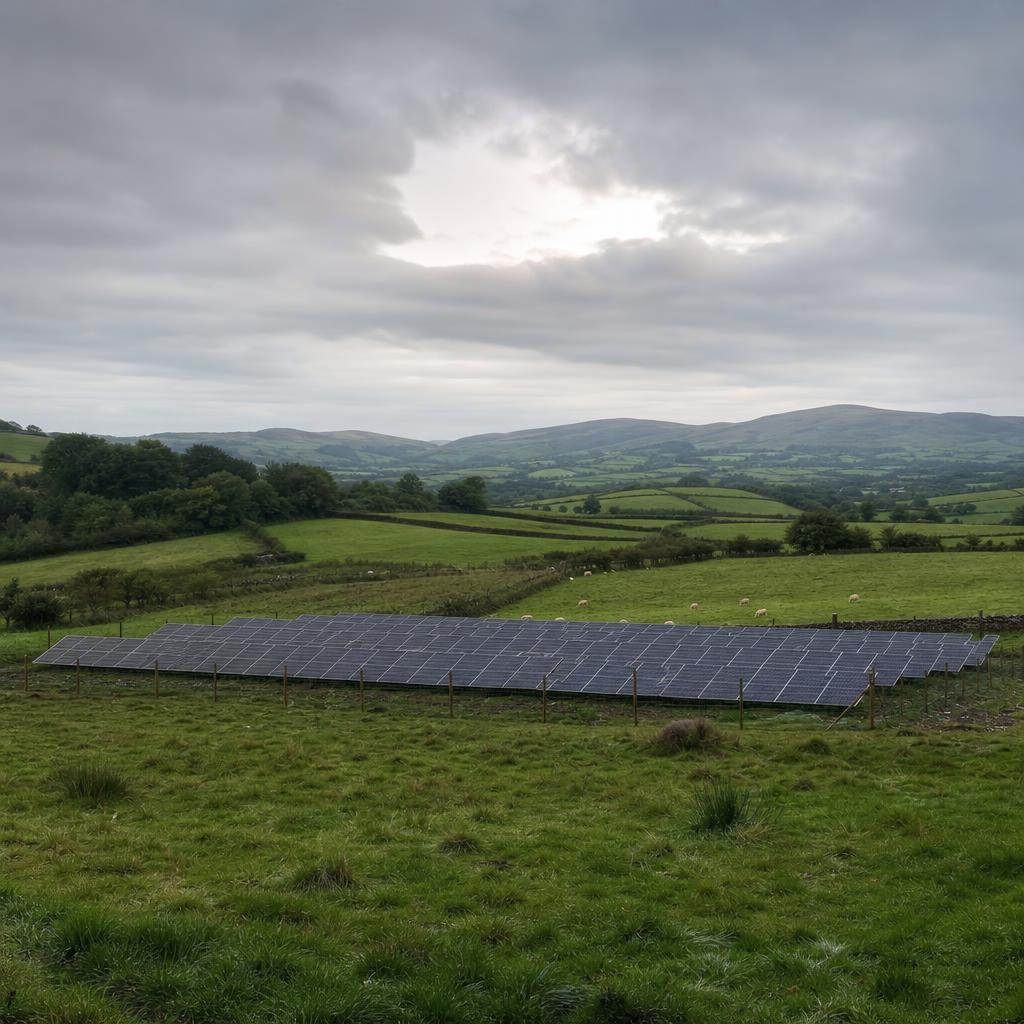
Irish farmers can consider solar as more than a way to reduce a dairy, poultry or tillage operation’s electricity bill. A suitable site may support a ground-mounted project exporting under the Small-Scale Renewable Electricity Support Scheme (SRESS), but the business case starts with land, grid and planning—not an equipment order. Capacity labels matter: ESB Networks’ inverter-connected small-scale generation category extends above mini-generation thresholds to 200 kVA; projects above 200 kVA use the large-scale connection process. SRESS is distinct, covering qualifying export projects above 50 kW, with farmer and SME projects eligible up to 6 MW.
A 250 kW project is a practical reference: roughly one to 1.5 hectares and indicative annual generation of 225–250 MWh, depending on location, orientation, shading, losses, curtailment and availability. At that size it would normally use the large-scale connection route; a design at or below 200 kVA may have a different process, but only network assessment establishes export capacity. A desktop review should map title, access, ground, shading, drainage, flood risk, ecology, archaeology, landscape, neighbours and cable route. A nearby line or substation does not prove capacity.
Engage ESB Networks early on installed and inverter capacity and maximum export. The network may offer the requested capacity, a lower limit or a connection needing reinforcement. Limited Maximum Export Capacity may be available in parts of mini- and small-scale processes, but heavy restriction can undermine an export-led model. Understand the offer before equipment commitment. A commercial ground-mounted project should normally expect a local-authority planning application and relevant surveys, addressing landscape, ecology, glint and glare, drainage, traffic, archaeology, fencing, CCTV, construction and decommissioning. Do not assume an agricultural-building exemption applies to a separate export project; early planning advice and neighbour engagement can reduce redesign risk.
The commercial choice is ownership or leasing/joint venture. Farmer ownership offers greater potential return but requires capital and leaves financing, performance and maintenance risk with the owner. A developer-funded lease or joint venture can provide rent or a negotiated income share with less capital at risk, but less control and upside. A dedicated project company can hold land rights, planning, connection, contracts, finance and revenue. Obtain legal and tax advice on structure.
Indicative costs show why the connection matters: 250 kW might require €200,000–€350,000, while 1 MW may need €700,000–€1.1 million or more. These are planning ranges, not quotations; grid works, ground, fencing, fees and finance can change them. Funding may combine farmer equity, bank or green-business borrowing, asset finance, investor or developer capital. Lenders will want evidence of land rights, planning, connection, warranties, construction, insurance, yield and revenue. Test repayments against conservative generation and delays, and allow for lifecycle costs such as inverter replacement.
As at September 2026, the published SRESS SME tariff is €130/MWh for qualifying solar projects above 50 kW up to 1 MW and €120/MWh above 1 MW up to 6 MW. Farmers apply on the same basis as SMEs. The tariff runs for 15 years without an auction as a two-way support arrangement around market revenue. The Department began reviewing rates in February 2026; confirm live eligibility and terms. Illustratively, 240 MWh exported at €130/MWh represents €31,200 gross supported value; 1 MW exporting 950 MWh at that rate represents €123,500. Neither is a net return: costs, insurance, metering, market participation, finance, tax, degradation, downtime and curtailment must be deducted.
A farm with high daytime demand may prioritise self-consumption. Behind-the-meter solar can displace purchases, with surplus potentially receiving a Clean Export Guarantee payment. The SRESS self-consumer route includes a Non-Domestic Microgen Grant for eligible projects above 50 kW and up to 1 MW, with support stated at up to €162,600. That grant and the SRESS export tariff cannot be claimed for the same project. Compare alternatives using half-hourly demand and export, not annual consumption alone, and confirm current grant terms.
Before construction, align modules, structures suited to Irish wind and ground, inverters, transformer, switchgear, monitoring, protection and grid interface as one compliant system. The EPC contract should define completion testing, delay responsibility, performance and defect correction. Include spares, warranty response and replacement beyond the 15-year support period. Operating revenue must meet maintenance, insurance, applicable rates, administration, debt service, tax and reserves before distributions. Assign monitoring responsibility; an inverter or communications fault can quietly interrupt generation.
The scale opportunity is a scenario, not a forecast. Around 3.75–5 acres may support 1 MW; 1,000 suitable farms each developing an average 250 kW would total 250 MW, and 2,000 would total 500 MW. Not every site is viable: weak capacity, expensive reinforcement, planning constraints, flooding, shading, fragmented land or finance costs can defeat the case. The checklist is to verify land, connection and planning; compare export with self-use; confirm SRESS; stress-test costs, generation and delay; and define finance, contracts and operating responsibility. OGMA can support specification, manufacturer qualification, factory assessment, procurement, logistics and solar-and-storage coordination. The objective is a maintainable asset with transparent costs and a revenue case grounded in the farm’s actual conditions.
0 Comments