

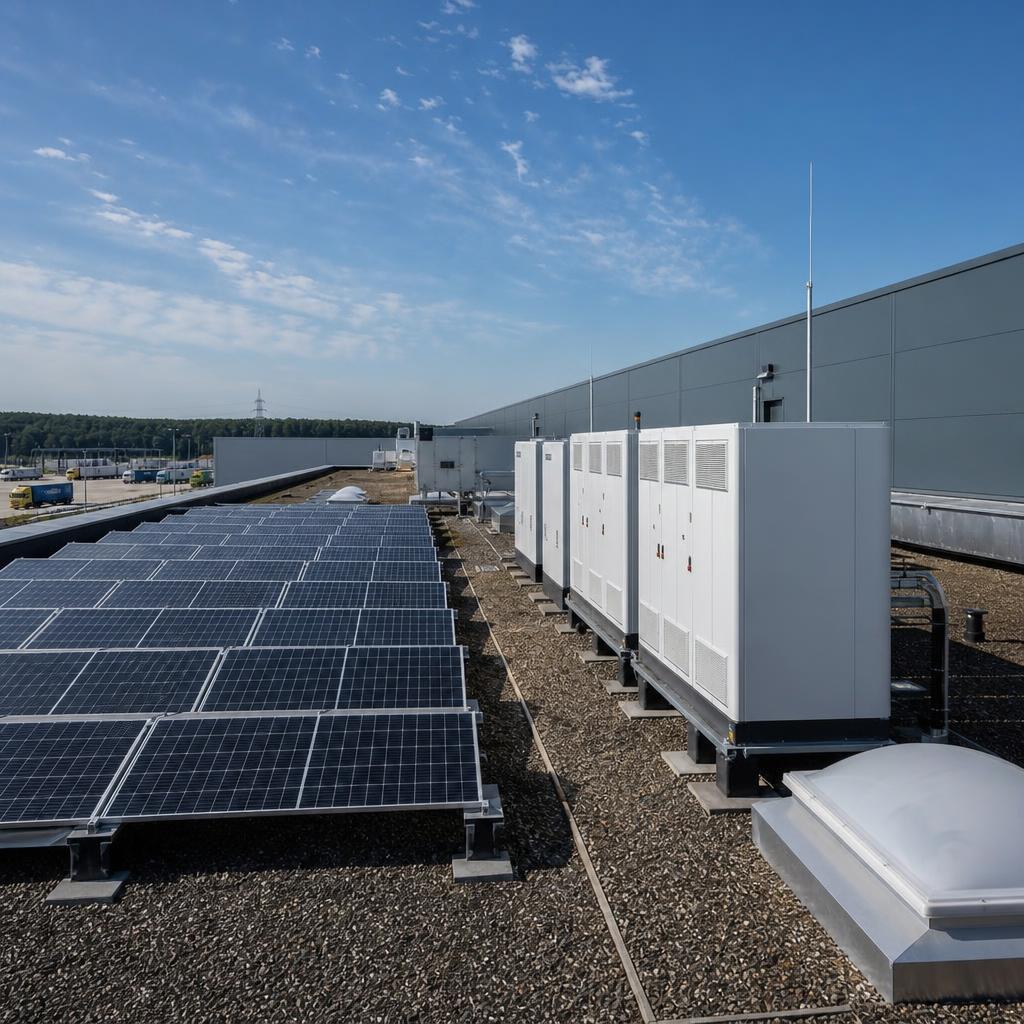
A Power Purchase Agreement (PPA) can make part of a UK solar project’s wholesale-market income more predictable, but it does not remove risk. It allocates price, volume, delivery, credit and operating responsibilities between generator and buyer. With a battery, the key decision is whether storage is committed to shaping contracted solar delivery or can also earn revenue through trading and grid services. Executives should settle this before treating a headline PPA price as bankable cash flow.
Consider an illustrative project with 1 MWp of solar and a co-located 1 MW / 2 MWh battery. Depending on location, orientation, weather, losses and availability, annual generation might be 850–1,050 MWh; this is an example, not a forecast. A battery creates no energy: it stores solar output or, if permitted, grid imports and returns less after losses. Its value comes from timing and flexibility, subject to connection limits, operating constraints and market access.
The offtaker may be a utility, licensed supplier, trader or corporate customer working through a licensed supplier. The project sells metered electricity and the offtaker manages or arranges market settlement in Great Britain. A corporate buyer may use the PPA to support renewable-energy objectives, but power moves through the public network unless a private wire connects the assets. Contractual supply and physical delivery are distinct, so claims about the arrangement should be precise.
A pay-as-produced PPA sells each metered MWh exported at a fixed, market-linked or floor price. If the illustrative project exported 950 MWh at £70/MWh, gross revenue would be £66,500 before route-to-market charges, imbalance costs, operating expenses, financing and tax. This is arithmetic, not a quote or forecast: price depends on contract date, term, credit quality, location, market conditions and risk allocation. Compare net proceeds, not price alone.
Volume terms determine who bears the gap between expected and actual output. Under pay-as-produced terms, the buyer accepts the actual profile, subject to forecasting and availability obligations. A fixed-volume or shaped PPA promises quantities in defined periods; a shortfall may require replacement power bought from the market. A 1 MW solar plant cannot promise flat 1 MW around the clock, and a 2 MWh battery can supply 1 MW for about two hours before losses and operating limits. Contracted delivery must match plant capability.
A battery can charge during high solar output and discharge later, shape delivery or help manage an export limit. The dispatch plan must weigh these benefits against round-trip losses, state-of-charge limits, degradation and the opportunity cost of storing energy instead of exporting it. Multiple revenue streams should not be added together as if capacity were always available: contracted delivery, trading and grid services may compete for the same battery hours. Specify dispatch priority, who controls charging and discharging, who pays for imported energy, who carries imbalance exposure and how degradation is treated.
Metering should distinguish solar generation, battery charging and discharge, grid imports, site consumption and net export. If grid charging is permitted, the parties need a method for identifying renewable output and certificates. The same MWh cannot be sold twice or represented simultaneously as solar generation and a separate battery service without a valid settlement and contractual basis. Eligible UK solar generation may receive Renewable Energy Guarantees of Origin (REGOs); establish whether they transfer to the buyer, stay with the project or are sold separately, and model any certificate value independently.
A bankable PPA addresses delivery point, term, indexation, metering, forecasting, curtailment, negative prices, outages, change in law, force majeure, credit support, default and termination. It should distinguish equipment unavailability from network constraints and allocate the consequences. Lenders consider the offtaker’s creditworthiness and cash-flow predictability. A longer fixed price may support debt but limit exposure to higher prices; merchant sales retain possible upside with greater uncertainty. Model contracted solar, battery trading, certificates and grid services separately, including fees, losses, downtime and degradation.
Before signing, ask whether delivery is physically achievable; who has dispatch priority; whether the battery can serve another market without breaching the PPA; how import, export, imbalance and curtailment costs are allocated; whether meters and controls support settlement; and who owns certificates and renewable claims. Test the financial case against lower generation, downtime and weaker merchant income, and review credit support and termination provisions. For the illustrative system, one possible structure contracts solar pay-as-produced while allowing the optimiser to shift a defined portion of output or pursue other markets when not needed for delivery. Safe limits come first, then contracted obligations, then discretionary trading. The precise structure depends on the connection, equipment and negotiated terms. OGMA can help define equipment and operating assumptions, assess suppliers and coordinate technical documentation so procured solar and BESS systems align with obligations; a PPA allocates risks, it does not guarantee profit.

0 Comments