

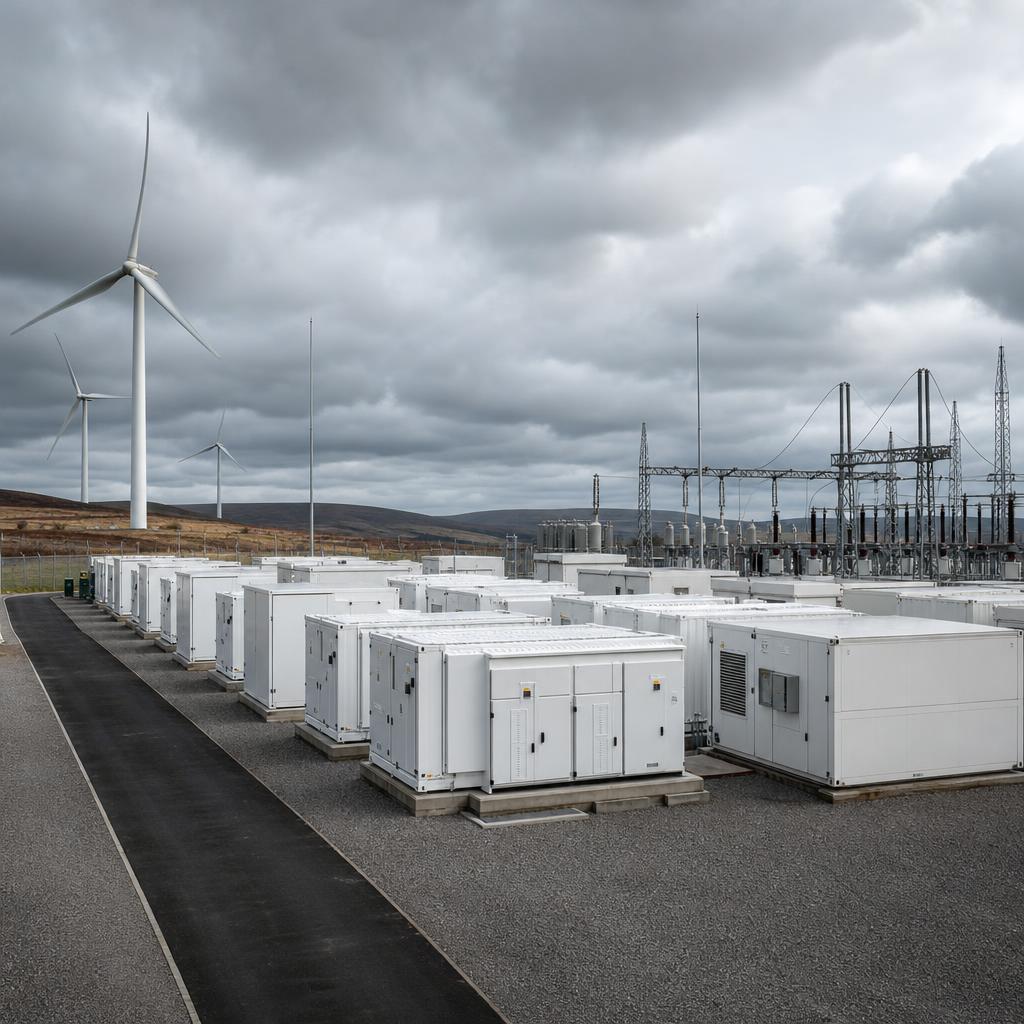
By February 2024, UK battery developers were looking beyond a single ancillary-services revenue stream and assessing how frequency response, wholesale trading and capacity mechanisms might work together. Revenue stacking can diversify potential income, but it does not make revenues certain. It changes the procurement question: can an integrated battery serve more than one market without compromising availability, safety, warranty protection or its long-term operating plan?
Each route has different requirements. Frequency response provides a defined system service subject to the relevant technical qualification and market arrangements. Wholesale trading seeks value from price differences over time and depends on price movements, forecasting and dispatch. Capacity mechanisms provide a separate route tied to availability under applicable rules. These services can compete for stored energy, power capacity and operating hours. A business case must test which can actually be combined, rather than simply adding headline revenue estimates.
The physical battery sets operating limits. Power describes how quickly it charges or discharges; energy capacity describes how much it stores; duration relates the two. Dispatch affects state of charge, efficiency losses, temperature and degradation. Committing capacity to one service may limit another opportunity or leave insufficient energy for a later obligation. An optimiser can manage these choices, but performance depends on market access, forecasting, control permissions and reliable operating data.
Prices, spreads, service requirements and market access can change, while competition may affect the value available. Treat revenue estimates as scenarios, not promises: separate contracted or defined income from merchant exposure, document the assumptions and test weaker spreads, fewer service opportunities, reduced availability and higher costs. Executives should understand dependence on individual products and whether project financing can withstand a period of weaker trading.
Procurement therefore extends beyond cell chemistry and cost per kilowatt-hour. Assess the complete system: cells and modules, battery management, power-conversion equipment, thermal management, fire protection, site controls, energy-management software and grid interface. Integration and responsibility boundaries matter; a capable component cannot compensate for unclear accountability, weak data or poor system integration. Specify who controls dispatch, resolves competing service commitments, measures performance and can access operational data. Consider what happens if communications or optimisation services fail. A sophisticated platform may expand options but increases dependence on software and service providers.
Warranty terms must match the intended operating regime. Check permitted cycling or throughput, temperature ranges, exclusions, degradation assumptions, response obligations and claim evidence. Warranty coverage is not the same as a performance guarantee and may not cover lost market revenue. Test any aggressive cycling assumption against warranty conditions and expected degradation. If strategy changes, confirm that the new use remains within the contracted operating envelope. Capacity can decline, so a lifecycle plan should consider whether augmentation may be needed, along with space, integration, downtime and cost responsibility; avoid assuming a date or cost without supplier and engineering evidence.
A practical procurement checklist is to define the intended services and constraints; request a transparent design, warranted operating envelope, efficiency and availability assumptions, degradation information, controls architecture, safety documentation, service response and spare-parts plans; and make responsibilities explicit. Compare bids on lifecycle suitability and risk allocation, not only initial price or nameplate duration. Confirm route-to-market and optimiser arrangements fit equipment capabilities, and ensure commissioning tests verify the functions underpinning the case.
There are trade-offs: a more flexible system may require greater integration effort and cost; intensive operation can increase wear; and one optimiser may simplify dispatch while concentrating operational dependence. A single-service strategy may offer less diversification but be simpler to manage. The right choice depends on connection, finance, market access, owner capability and tolerance for merchant risk.
For executives, stacking is a whole-life risk allocation decision. Assess whether suppliers can substantiate technical capability, support controls and warranties under the planned regime, and provide service over the asset’s life. OGMA can help clients assess equipment options, manufacturers and supply arrangements against those requirements. A battery is not merely a box of cells: its commercial potential relies on coordinated technology, disciplined operation and credible long-term support.


0 Comments