

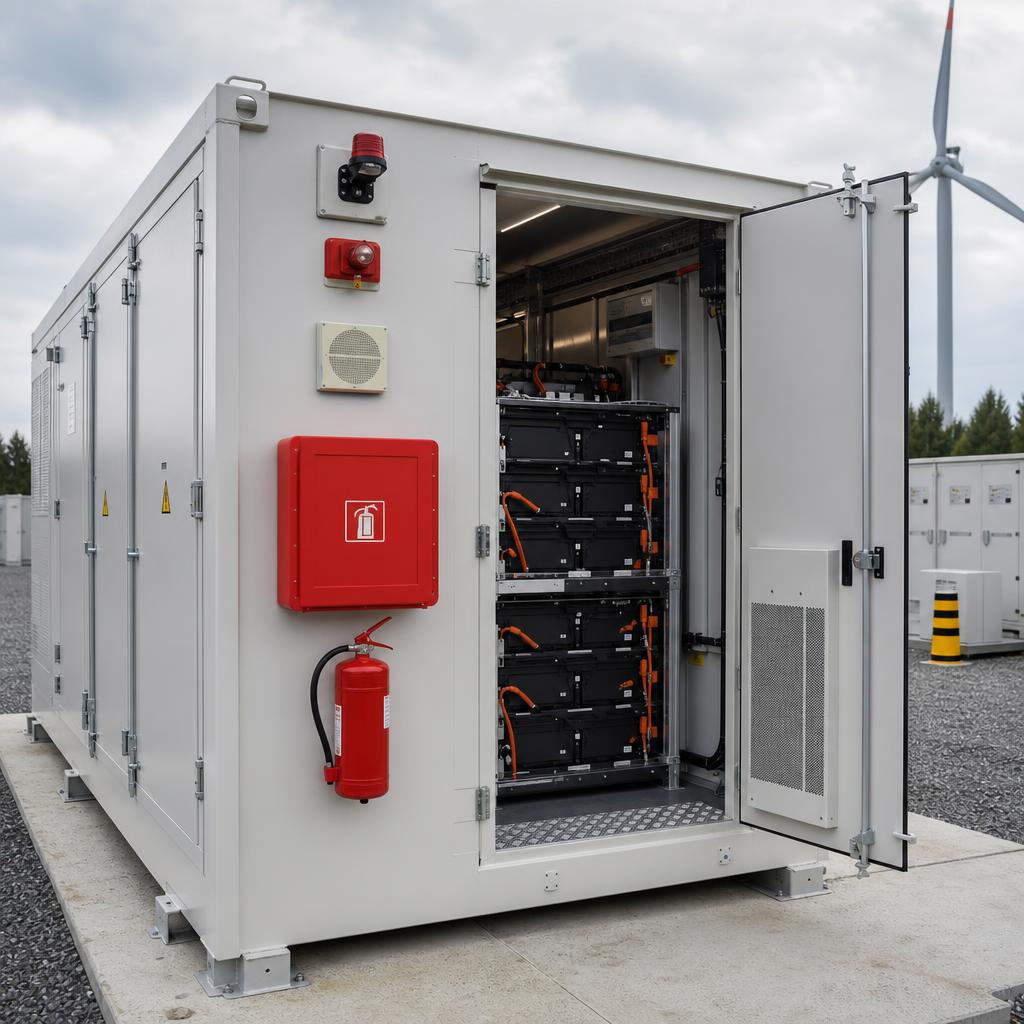
Battery safety is an architectural and operational decision, not a certificate to collect at the end of procurement. For European battery energy storage system (BESS) projects, cell selection, electrical design, enclosure layout, detection, mitigation, access and emergency planning interact. Executives should therefore make safety requirements part of the project brief before the system is specified and ordered. Late changes can be technically difficult, commercially expensive and disruptive to planning, grid interfaces and the delivery programme.
The first task is to define the system boundary and operating context. A containerised solution, an indoor installation and a site with different neighbouring uses do not present identical design conditions. Teams should document the proposed location, installation arrangement, access routes, operating profile, maintenance approach and interfaces with surrounding infrastructure. That description gives suppliers, designers and the project’s safety specialists a shared basis for assessing hazards; generic product literature cannot replace a site-specific review.
Cell chemistry is one input, not a complete safety conclusion. Different chemistries have different characteristics, but the safety case also depends on cell quality, module and rack design, electrical protection, controls, enclosure construction, thermal management and how failures are detected and contained. Buyers should ask what evidence supports the supplier’s claims, which configuration was tested, and whether the offered project design matches the tested arrangement. A test report for a component or a different layout should not be treated as proof of the performance of the full installation.
Propagation testing deserves particularly careful interpretation. It can provide evidence about whether a failure in one cell or unit spreads under defined test conditions, but the test method, boundaries, instrumentation and acceptance criteria matter. The procurement team should establish what was tested, at what scale and under which operating or failure scenario, then ask qualified technical advisers to assess how relevant that evidence is to the planned system. Avoid reducing a complex safety question to a single pass label or assuming one test result settles every hazard.
System-level protection should be specified as coordinated layers. Depending on the design, these may include monitoring, alarms, isolation, ventilation or other thermal-management functions, fire detection and suppression provisions, separation, access controls and procedures for shutdown. The project should confirm which functions are included in the battery supply and which sit with the integrator, EPC contractor, site owner or emergency-planning process. Unclear boundaries can leave a gap precisely where equipment packages meet. The design should also address maintenance and safe access, not only a theoretical fault event.
Emergency planning is a project responsibility with local context. The owner and relevant professionals should establish how responders can reach the site, identify the installation, access reliable system information and understand isolation points and hazards. The appropriate arrangements depend on site layout and the applicable authority and emergency-service processes; a supplier’s standard manual is a starting point, not a substitute for local engagement. Plans should be kept current as the site changes and made available to those who need them.
The supply chain must preserve configuration and quality evidence. Buyers can require traceability from cells and modules through racks and containers, controlled records of manufacturing and inspection, and a clear process for handling deviations. Factory quality plans, incoming inspection, test records, serial numbers and change notifications should be agreed in a form the project team can verify. A component substitution may affect compatibility or the relevance of prior testing, so change control needs to cover both technical approval and updated documentation.
Contract and warranty reviews should align with the safety design without implying that contractual wording alone controls physical risk. Teams should understand who is responsible for design integration, commissioning, training, incident notification, software updates, maintenance and corrective action. Warranty exclusions, operating limits and required service practices should be visible to the asset owner and operator. If safety functions rely on sensors, communications or control logic, the operating team needs clarity on alarms, fault escalation, testing and the consequences of unavailable functions.
Before order placement, executives can use a focused checklist: is the site and system boundary documented; have qualified specialists reviewed the hazard assessment; are relevant test reports tied to the offered configuration; are protection functions and package interfaces allocated; is emergency access considered with local stakeholders; are factory quality and traceability records defined; and are commissioning, operating and maintenance responsibilities clear? Unanswered items should be tracked as decision gates, not buried in open-ended supplier correspondence.
The practical implication is to involve safety and operations expertise early enough to influence architecture, while keeping procurement decisions traceable and proportionate to the project. OGMA’s supported relevance is in supplier assessment, factory and quality review, technical documentation and coordination of equipment sourcing; those activities can help clients establish evidence across the chain, but do not replace specialist engineering, regulatory advice or emergency planning. Procurement is strongest when its safety requirements are explicit before an order, verifiable on delivery and usable by the people responsible for operating the system. Mitigation choices also involve cost, space and maintenance trade-offs, so they should be proportionate to the site assessment and clearly owned.



0 Comments